How it works
Here's exactly what happens.
No mystery, no discovery phase that quietly becomes a project. Five steps, roughly four weeks, and you can see the whole thing before you commit to any of it.
Discovery
We ask about your book: how many clients, which industries, where the calls come from and when. Then the specific question that matters — which one or two client accounts would be the safest place to try this first.
We're also qualifying ourselves out. If your call mix is genuinely complex, or your clients are all high-touch relationship accounts where a caller expects a specific person by name, we'll say so. Selling you something that fails in month two isn't good business for either of us.
Configuration, together
We build your first agent live, with you watching and directing. That means:
- Your greeting, in your words — not a template's
- The questions the agent asks callers, mapped to what your client actually needs captured
- Business hours, service areas, the things your client's customers always ask
- Escalation rules: what gets forwarded, what gets messaged, what's urgent
We do it on a call rather than sending you a login because the tenth question is always the useful one, and you don't ask it to a help centre. By the end you'll have watched the whole thing get made, which is what lets you edit it yourself later.
Watch an AI Agent at work
Don't take our word for it.
Two minutes, watch a test call with a working AI Agent. This is the actual session, at the actual speed.
Testing with real calls
Nothing goes near a client until you've heard it handle their kind of call. We run the agent through real scenarios pulled from your own book — the awkward ones, the accents, the caller who interrupts, the one who asks something off-script.
You listen to the recordings. You tell us what's wrong, in your own words: too formal, missed the point, should have transferred that one. We adjust and run it again. Repeat until you'd be comfortable if that call had been real.
Go-live
We start deliberately small: one client, one call type, usually after-hours only. Human escalation live from the first call. You watch the first day's transcripts the way you'd watch a new hire's first shift.
Then you widen it — more hours, more call types, more clients — at whatever pace your own confidence allows. Every expansion is your decision, not a schedule we set.
The first 30–60 days
This is the part other providers don't do, and it's the reason projects like this succeed or quietly stall.
- Weekly calls while volume ramps — what's working, what needs tuning
- Transcript reviews so problems get caught in week two, not month four
- Dashboard walkthrough so you can present results to your own client with numbers rather than assurances
- Configuration coaching — by the end you're making changes yourself, without us
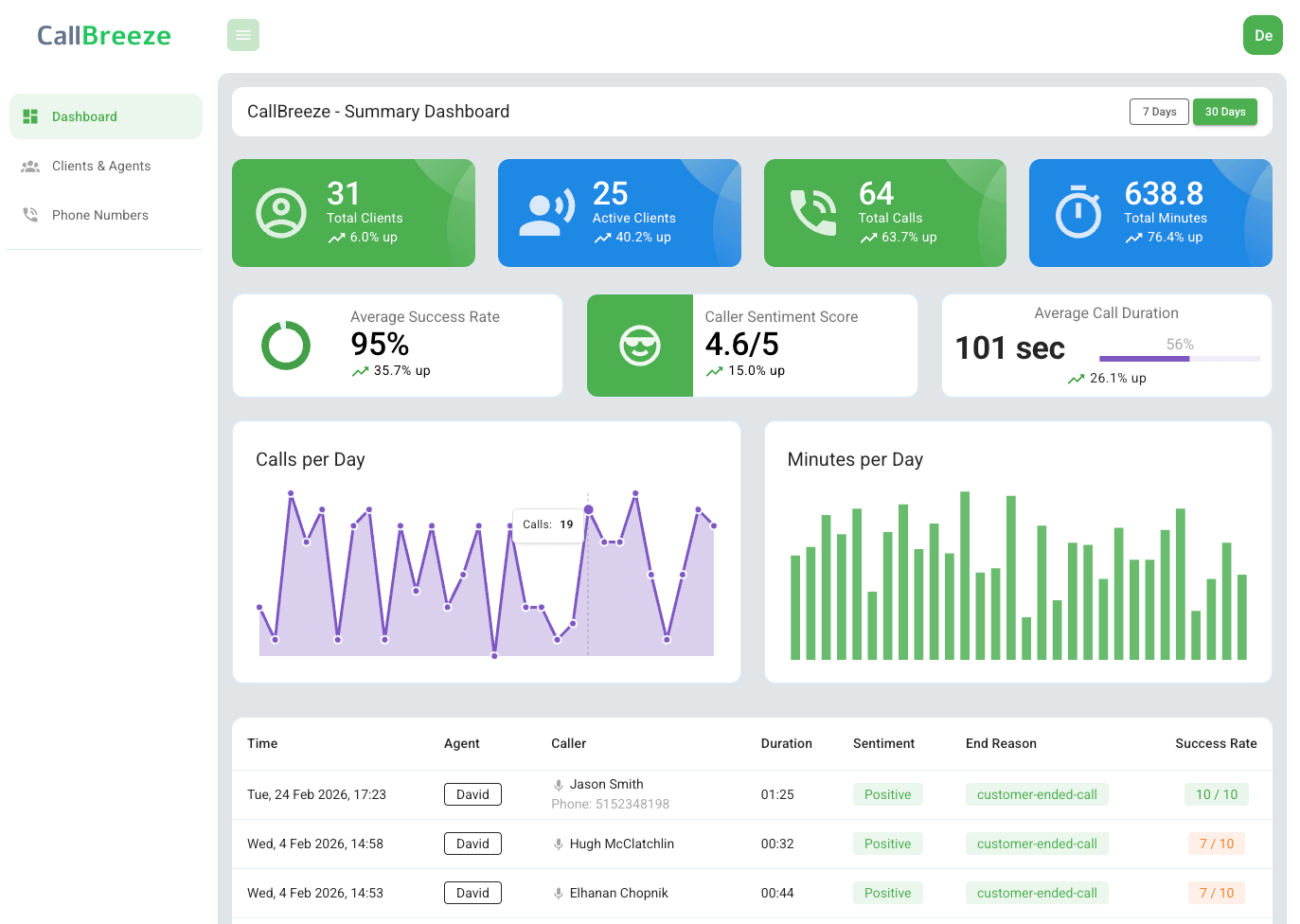
At day 90 the goal is that you don't need us for day-to-day. We're the call you make when something changes: a new vertical, a new client, a new idea.
And if it doesn't work?
Then you've spent 60 days and learned something specific about your business, and you keep the configuration and every transcript. We'd rather have an honest no at day 90 than a partner who never quite went live and stopped taking our calls.
Book a 20-minute call